
The ASCENDER project, led by Eduardo Quiñones, a senior researcher in the Computer Science department at the Barcelona Supercomputing Center (BSC), has concluded, having successfully deployed a software architecture for continuous computing environments for the efficient development, deployment, and execution of extreme data analysis methods.
The goal of ASCENDER was to integrate the most relevant technologies to enable the application of analysis methods for extremely large, constantly growing, scarce, dispersed, and heterogeneous datasets.
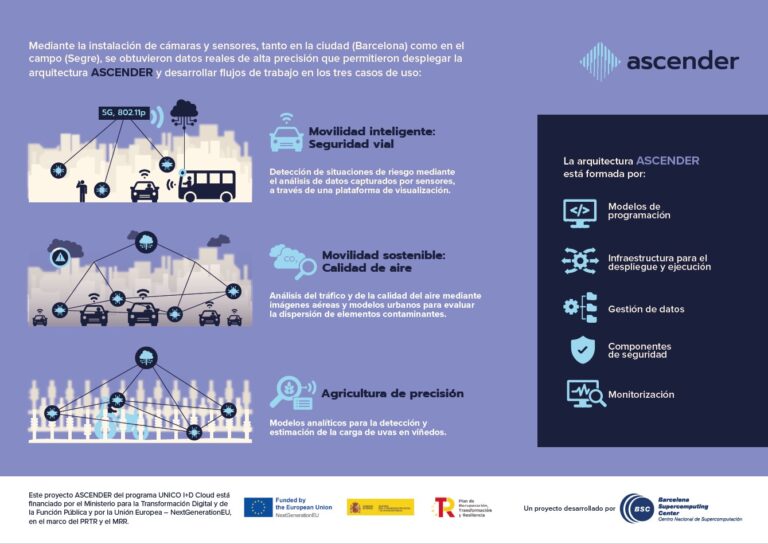
To achieve this, the project implemented a software architecture for the efficient development, deployment, and execution of complex workflows for knowledge extraction in a continuous computing environment. The ASCENDER architecture consists of the following main components:
- Programming models for workflow descriptions.
- Infrastructure for workflow deployment and execution.
- Management of persistent data and streams.
- Security components.
- Monitoring.
To develop workflows for analysing extreme data, the project implemented three use cases:
- Air quality: in which analytics were developed for vehicle detection and acceleration using images from high-altitude cameras.
- Road safety: in which semantics were developed for detecting risk situations based on the presence of different road users.
- Agriculture: in which models were developed for detecting grape yields in vineyards.
In this regard, the data used in the first two use cases was obtained through the installation of camera, computing, and communication sensors with the “Official Maintenance” personnel of the city of Barcelona, at the intersection of Urgell Street and Roma Avenue; in addition to the installation of passive pollution sensors in the Eixample district of Barcelona. For the agriculture use case, sensors were installed in vineyards in the Costers del Segre area.
Thus, the main software components for the architecture have been identified, and a study of solutions for describing workflows has been carried out, both for computing and data management, enabling the deployment of the ASCENDER architecture.
Finally, it should be noted that this project is part of the UNICO R&D Cloud program and is funded by the Ministry for Digital Transformation and Public Administration and by the European Union – Next Generation EU, within the framework of the PRTR and the MRR.